
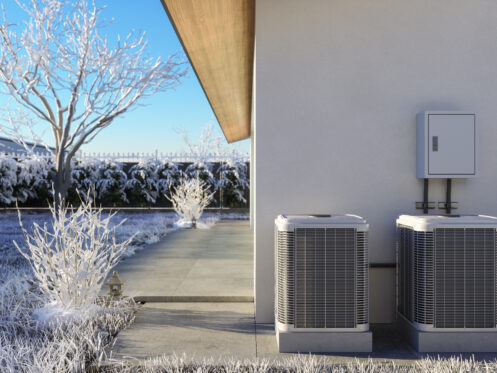
Even in colder places, heat pumps are among the most energy-efficient ways to heat a home. Their high workload creates the potential for various issues to arise, especially in colder climates. One fairly common problem you can encounter during the winter is a heat pump system suddenly putting out cold air. Here, we’ll examine the causes of your heat pump blowing cold air and take you through the basic troubleshooting steps to resolve this issue.
Incorrect Thermostat Settings
The first thing to check when your heat pump is blowing cold air is to see if your thermostat is set correctly. That means the thermostat should be set to “Heat” mode, and the fan should be set to “Auto.” The system will obviously blow cold air if someone accidentally switches the thermostat to “Cool” mode. If the fan is set to “On,” the blower will run constantly and quickly start circulating cooler air whenever the heat pump shuts off.
Clogged Air Filter
The next thing to do is check the air filter. A clogged filter restricts the amount of air that the blower can draw into the air handler. When the incoming airflow is restricted, the system can’t distribute nearly as much heat.
If the air filter is starting to turn dark or is covered with a layer of hair, dust, and debris, you should shut your heating system off at the thermostat and then replace the filter. You never want to remove the air filter when the system is running, as this allows dust and debris to get sucked into the air handler. If the problem was that the filter was clogged, the system should start blowing warm air again almost as soon as you turn it on.
Heat Pump Is Frozen
The refrigerant in a heat pump system is so cold when it initially enters the coil in the outdoor unit that frost and ice naturally form on the coil in colder conditions. The coil is so cold that frost forms even when the temperature outside is above freezing. Ice buildup blocks air from reaching the coil, preventing the refrigerant from absorbing any heat. That means the system will start blowing cold air until the coil thaws out.
Heat pumps overcome this problem by occasionally switching from heating mode to defrost mode. Many older systems have a timer that causes the defrost cycle to run at set intervals. Most newer systems have a sensor that detects the coil’s coldness and signals the defrost cycle to start when the coil starts to freeze. During the defrost cycle, the blower stops running to prevent the system from circulating cold air. The reversing valve also switches the direction of the refrigerant flow, allowing hot refrigerant to flow outside and quickly melt the ice on the coil.
There can be situations where the system fails to switch to defrost mode when needed, resulting in the system then blowing cold air. Older systems with a timer may not switch to defrost mode often enough when it’s cold outside. An issue with the temperature sensor, the control board, or the reversing valve can also prevent the system from switching to defrost mode.
You can easily tell if your heat pump is blowing cold air. If your heat pump is blowing cold air, go outside and check the system for ice buildup on the refrigerant lines. If there’s significant ice buildup and the unit doesn’t defrost within a few hours, you’ll need to have it inspected.
Insufficient Refrigerant Charge
If a heat pump system develops a leak in one of the coils or one of the refrigerant lines, it will eventually lose enough refrigerant that it can no longer work effectively. The refrigerant absorbs heat from the outside and transfers it to the air flowing through the air handler inside. If the system doesn’t have enough refrigerant, it won’t transfer nearly as much heat into your indoor space. That means the air will barely get heated as it flows through the air handler and will feel cool when it exits the vents.
Unfortunately, a refrigerant leak is among the worst problems you can encounter due to how expensive it can be to repair and then recharge the system with additional refrigerant. If either of the coils is leaking, you’ll typically have to pay over $1,000 to have a technician replace the coil. It’s also necessary to first drain and capture all the refrigerant before fixing the leak, which can sometimes take several hours.
Bean's Heating & Air has decades of experience providing top-notch HVAC services in Portland and throughout Southern Maine. When you experience heat pump issues, you can rely on us for prompt, dependable repairs. Scheduling seasonal tune-ups is also an easy way to avoid heat pump problems throughout the year. For heat pump services, contact our experts at Bean's Heating & Air.